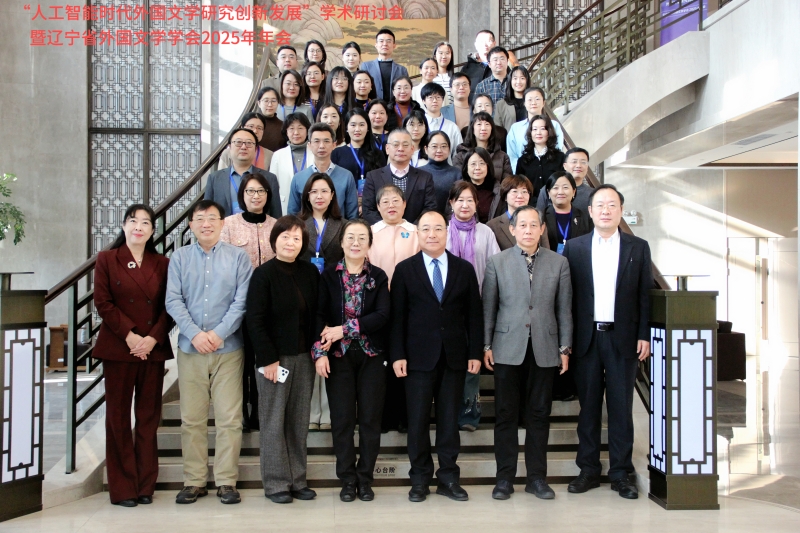
On December 14, the Academic Symposium on "Innovative Development of Foreign Literature Research in the Age of Artificial Intelligence" and the 2025 Annual Meeting of the Liaoning Provincial Foreign Literature Association were held at the International Cultural Exchange Center of our university. Scholars, experts, teachers, and students from higher education institutions across and beyond the province gathered together, using academia as a bridge to engage in in-depth discussions on the new pathways, challenges, and opportunities for foreign literature research empowered by artificial intelligence technology, jointly envisioning the future development of the discipline.
Professor Cong Mingcai, President of Dalian University of Foreign Languages, delivered the opening speech. On behalf of the university, he extended a warm welcome to the attending experts and scholars and expressed sincere gratitude to colleagues who have long supported the development of both the university and the Liaoning Provincial Foreign Literature Association. President Cong Mingcai introduced the educational heritage and disciplinary strengths accumulated over more than six decades at Dalian University of Foreign Languages, as well as the university's exploratory achievements in the field of digital humanities. He emphasized that this symposium, focusing on the deep integration of technology and humanities, is not only a crucial practice in responding to the issues of our time but also injects new momentum into the high-quality development of the foreign language and literature discipline. He expressed hope that experts would spark ideas through exchange while preserving the humanistic warmth of literary research.
Subsequently, Professor Sun Yuhua, President of the Liaoning Provincial Foreign Literature Association and a professor at Dalian University of Foreign Languages, delivered a keynote report. She pointed out that artificial intelligence, as a core driving force leading the technological revolution and industrial transformation, is comprehensively reshaping the production models, thinking logic, and cultural ecology of human society, bringing about a methodological "Copernican revolution" to foreign literature research.
The conference featured nine parallel forums, showcasing over 120 academic achievements. While scholars engaged in thorough discussions on fundamental topics of interdisciplinary research in foreign literature, more than one-third of the presented works focused on the "innovative development of foreign language and literature research in the age of artificial intelligence," covering cutting-edge directions such as AI-powered literary teaching, literary translation, text topic modeling, and sentiment analysis. During the group discussions, experts and scholars expressed their views and exchanged ideas enthusiastically, transforming intellectual collisions into academic consensus and building strong synergy for the discipline's advancement.
This symposium established an academic exchange platform for foreign literature research in the age of artificial intelligence. Participants unanimously agreed that, amid the wave of digital humanities, foreign literature research should embrace technological empowerment with an open mind to expand research boundaries and methods, while also upholding humanistic foundations, guarding against technological risks, and constructing China's own autonomous knowledge system for foreign literature. As the host institution of the Liaoning Provincial Foreign Literature Association, the university will continue to deepen the development in the field of digital humanities, promote interdisciplinary cooperation and the cultivation of interdisciplinary talents, and contribute more academic strength to the exchange and mutual learning between Chinese and foreign civilizations, as well as to the development of Liaoning as a culturally strong province. (By Chai Hongmei, Dong Wei)



