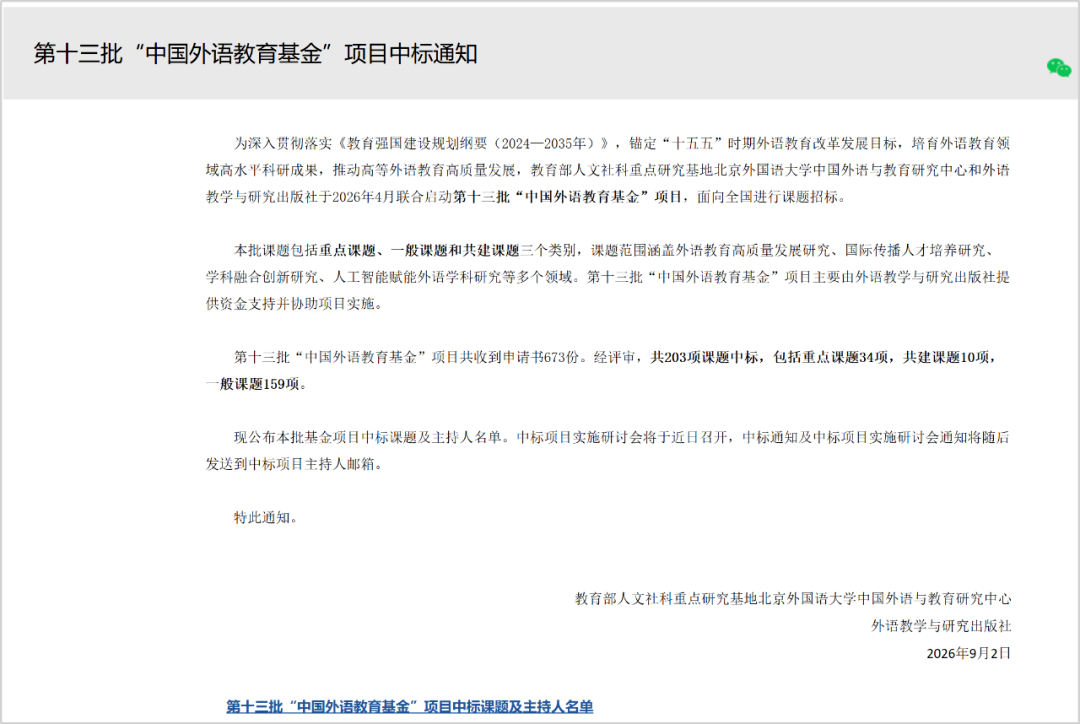
This batch of “China Foreign Language Education Fund” projects was jointly organized and implemented by the Research Center for Chinese Foreign Language and Education Studies at Beijing Foreign Studies University—a key research base for humanities and social sciences under the Ministry of Education—and the Foreign Language Teaching and Research Press. The projects are divided into three categories: key projects, general projects, and jointly-constructed projects. Following rigorous expert review, a total of 203 projects out of 673 nationwide applications were approved, of which only 34 were key projects. The topics of the approved projects focus on frontier areas such as the high-quality development of foreign language education, the cultivation of talents for international communication, interdisciplinary integration and innovation, and AI-empowered foreign language education, fully reflecting the trend of new-era foreign language education research toward digital and intelligent transformation.
The research project “A Study on Cultivation Paths for Translation Talents’ Critical AI Literacy in the Digital-Intelligence Era,” led by the team of Associate Professor Xu Dan, is grounded in the rapidly evolving context of digital-intelligence technology and focuses on the new opportunities and challenges facing the cultivation of translation talents. The project will conduct systematic research on the definition, competency structure, and cultivation mechanisms of translation talents’ critical AI literacy, explore cultivation paths for translation talents that meet the needs of the digital-intelligence era, and further broaden the research perspective of AI-empowered translation education. It aims to provide references for translation program course development, teaching model innovation, and the cultivation of high-caliber translation talents.
In recent years, the School of Advanced Translation Studies has continuously deepened the coordinated development of research innovation and talent cultivation, actively positioning itself at the forefront of research integrating artificial intelligence, translation technology, and translation education. The approval of this key project represents another important achievement for the school in the field of AI-empowered translation education, and serves as a strong demonstration of the school’s proactive response to the industry’s demands in the digital-intelligence era and its commitment to advancing innovation in the translation talent cultivation model.
Looking ahead, the school will take this opportunity to further deepen research on the integration of artificial intelligence and translation education, channel research outcomes back into course development and teaching practice, and continue to explore new concepts, models, and pathways for cultivating translation talents in the digital-intelligence era—contributing more practical experience and research findings to the digital transformation of foreign language education and the cultivation of high-level translation talents. (Zou Jinchi)



